Wednesday, August 20, 2014

Bitcoin Gets Capital Gains Tax Break, Why Not Gold?

Late last year ('Glenn Stevens Talks Bitcoin & Competing Currencies') I pointed out that Bitcoin effectively can't be used as a competing currency (likewise for foreign currency or other assets such as Gold) given that it is subject to Capital Gains Tax (CGT) and monitoring the value of Bitcoins as they are acquired and disposed of would not be practical:
"Can you just imagine the administrative nightmare that would result from performing regular transactions in a foreign currency and having to maintain a record of whether you made a gain or loss as a result of fluctuation in the currency markets? It is simply not practical. Bitcoin is not immune from the same requirements." - Bullion Baron
However, earlier today the Australian Tax Office (ATO) released a statement (ATO delivers guidance on Bitcoin) in regards to Bitcoins and their tax treatment. Further information is available on the following page 'Tax treatment of crypto-currencies in Australia – specifically bitcoin' which specifies the following in regards to Bitcoins used in personal transactions:
Using Bitcoin to pay for personal transactions
Generally, there will be no income tax or GST implications if you are not in business or carrying on an enterprise and you simply pay for goods or services in bitcoin (for example, acquiring personal goods or services on the internet using Bitcoin). Where you use bitcoin to purchase goods or services for personal use or consumption, any capital gain or loss from disposal of the bitcoin will be disregarded (as a personal use asset) provided the cost of the bitcoin is $10,000 or less.
The 'personal use asset' exemption would normally be reserved for items such as a boat, furniture, electrical goods or other household items which are exempt from CGT if purchased for less than $10,000.

The wording on the ATO website is somewhat ambiguous. Does the limit apply per year or can I buy low (to a maximum of $10,000 worth of Bitcoin) and spend high several times in the same financial year and still avoid CGT?

I think this is a good start and would like to see a similar CGT exemption for Gold (as I suggested last year in 'Let Australians Save in Gold Instead of Debt'). That said, I think the limit imposed is patronizing, why impose a limit at all if the Bitcoins are being purchased with the intention of spending them at a later time? Putting a $10,000 cap on the exemption limits the spending of Bitcoins to novelty use only, it wouldn't be adequate for someone having their income paid in Bitcoins, which was also covered on the site:
Paying salary or wages in bitcoins

Where an employee has a valid salary sacrifice arrangement with their employer to receive bitcoins as remuneration instead of Australian dollars, the payment of the bitcoins is a fringe benefit and the employer is subject to the provisions of the Fringe Benefits Tax Assessment Act.

In the absence of a valid salary sacrifice agreement, the remuneration is treated as normal salary or wages and the employer will need to meet their pay as you go obligations as usual.
I would like to see any monetary asset (Bitcoin, Gold or otherwise) that is saved for future consumption be exempt of Capital Gains Tax. That would allow us to truly have competing currencies in Australia. Being forced to save in a currency whose value is purposefully devalued (via central bank mandate to target 2-3% annual inflation) is madness, especially when interest earned on those savings is taxed and with the real cash rate already below 0.


Those who have purchased and sold Bitcoin specifically for investment are subject to CGT (or taxed as part of your income if traded in the business of regular profit-making):
Disposing of bitcoin acquired for investment

If you have acquired bitcoin as an investment, but are not carrying on a business of bitcoin investment, you will not be assessed on any profits resulting from the sale or be allowed any deductions for any losses made (however, capital gains tax could apply – although see the comments above about personal transactions). However, if your transactions amount to a profit-making undertaking or plan then the profits on disposal of the bitcoin will be assessable income.

There are no GST consequences where the bitcoin is not supplied or acquired in the course or furtherance of an enterprise you are carrying on.
There is another section for those in the business of mining Bitcoins:
Mining Bitcoin

Where you are in the business of mining bitcoin, any income that you derive from the transfer of the mined bitcoin to a third party would be included in your assessable income. Any expenses incurred in respect to the mining activity would be allowed as a deduction. Losses you make from the mining activity may also be subject to the non-commercial loss provisions.

Your bitcoin is trading stock and you are required to bring to account any bitcoin on hand at the end of each income year.

GST is payable on the supply of bitcoin made in the course or furtherance of your bitcoin mining enterprise. Input tax credits may be available for acquisitions made in carrying on your bitcoin mining enterprise.
The section that deals with ATMs and exchanges is probably the most off putting with an indication that businesses in this area will need to charge Goods and Services Tax (GST), likewise in the supply via mining as mentioned above:
Taxpayers conducting a bitcoin exchange (including bitcoin ATMs)

Where you are carrying on a business of buying and selling bitcoin as an exchange service, the proceeds you derive from the sale of bitcoin are included in assessable income. Any expenses incurred in respect to the exchange service, including the acquisition of bitcoin for sale, are allowed as a deduction. In these circumstances, the bitcoin is trading stock and you are required to bring to account any bitcoin on hand at the end of each income year.

GST is payable on a supply of bitcoin by you in the course or furtherance of your exchange service enterprise. Input tax credits are available for bitcoin acquired if the supply of bitcoin to you is a taxable supply.
This seems to put local Bitcoin exchange and supply businesses at a competitive disadvantage if they have to charge buyers a 10% premium. It would be likely to drive Australian Bitcoin buyers to international sources which don't charge GST.

It is good to see that the ATO has finally addressed Bitcoins for tax purposes, but I don't think they've done a particularly good job here.


Every post delivered to your inbox (free), enter your email address:


I'm sharing links and opinions daily on Twitter (@BullionBaron).


BB.


 Buy bullion online - quickly, safely and at low prices

Monday, August 4, 2014

Replica vs Real: 1oz Gold PAMP Bar Comparison

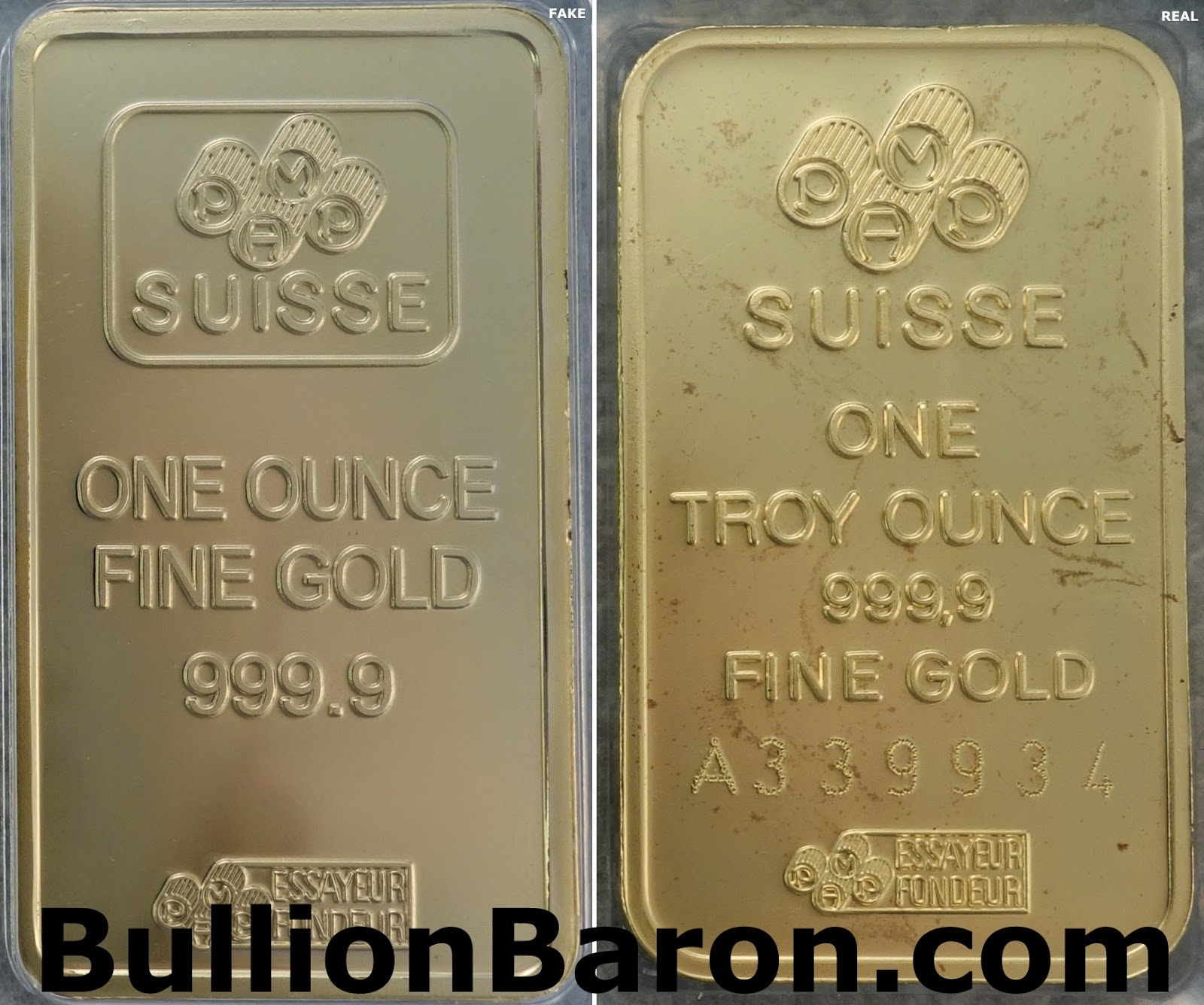
It was bought to my attention that there are fake Gold bars being sold on ebay that replicate popular investment grade 1oz Gold bars. On this occasion they were being advertised as pure bars in the title, but if you read the full description it did state they are only layered in pure Gold. Having some real PAMP 1oz Bars myself I decided to buy one of the replicas to provide a comparison for others (and it arrived late last week). 

I have written about fake Gold and Silver products in the past, you can read my previous posts at these links:

Warning: Fake/Counterfeit Silver & Gold

Counterfeit Silver Lunar Dragons - Don't Get Stung!

Fake/Counterfeit Silver Lunar Coins on eBay, BEWARE! (Perth Mint Replicas)

The ebay auction from which I purchased my fake bar was titled “1 Oz Switzerland Pamp Suisse PURE 24K .999 1oz Gold Bullion Coin Bar Ingot”. The full description was as follows:
VERY RARE AND VERY LIMITED CAST

Brand new "1oz Switzerland Pamp Suisse bar " This bar is not solid gold.  It is clad/layered in pure fine 100Mills of 24k gold. This is a high quality item beautifully designed and manufactured to very high standard by master craftsmen in a small family owned mint in Australia.

Weight 1 ounce. 30 grams.

DONT MISS YOUR CHANCE TO OWN THIS BEAUTIFUL PIECE . A GREAT GIFT OR ADDITION TO YOUR OWN COLLECTION.

Beautifully designed and this Gold Bullion bar will be delivered to you in a free protective airtight capsule.
The title and parts of the description appear intentionally worded to try and deceive unwary buyers into mistaking it for a pure Gold bar from PAMP Suisse, even if it did also mention that it’s not solid and clad/layered. This reminds me of the old ‘console box’ scam where a seller advertises the box of a new console, stating as such, but obviously intending for buyers to bid thinking it’s the whole system. 

The seller of the fake Gold bar also suggested in the description that it was manufactured in Australia, when it’s clearly just a Chinese knockoff, likely to have been purchased from Alibaba (China's biggest online commerce company, which will be floated on the stock market later this year). Further to the misleading wording, the auction also had 3 images, the first two images depicted a real PAMP Suisse 1oz Gold Bar, with the final image showing one of the fake bars the buyer will actually receive.

Below is a photo comparison of the fake bar I received and a real bar, can you tell which is which before enlarging to view the detail and labels? See the top right corner of each image for the answer (click each image to enlarge):


Without the cropping it becomes a lot more obvious which is the fake, see below for a size comparison (click the image to enlarge):


Some obvious design differences include:

- No border around 'PAMP Suisse' logo on real bar
- Missing 'TROY' in text on fake bar (and wording order differs)
- Missing serial number on fake bar
- Corners are more rounded on real bar
- Detail on 'Lady Fortuna' design more intricate on real bar
- Real bar has a stronger yellow hue under the same lighting

Here are some specifications showing the weight and size difference between the fake and real PAMP Suisse bar…

Weight of fake bar (in plastic): 39.80g
Weight of real bar (in plastic): 36.28g

Weight of fake bar (out of plastic): 31.49g
Weight of real bar (per official specifications): 31.10g

Measurements of fake bar: 50 x 28 x 3 (mm)
Measurements of real bar (per official specifications): 41 x 24 x 1.70 (mm)

In this case it was relatively easy to differentiate the fake from the real bar, but keep in mind a copy like this can be purchased in bulk for less than US$1 per piece. There’s nothing to say that better quality fakes (including replication of the official packaging) might be out there. If they can produce this for less than a dollar, then imagine the quality of fake they could produce for $10.

By the way, if you were wondering about the red spots on the real bar, they are a common occurrence even on pure Gold bars and coins (via Lynn Coins):

Gold coins (and even pure gold bars) can sometimes develop brown (rust colored spots) on them. Yes, a gold plated item (when the gold plating wears off) would expose the non-gold metal underneath and that exposed metal could tarnish or rust. However, a brown or reddish spot on gold doesn't mean the item is not real solid gold. Here's why:

Rust spots or brown spots can occur on genuine gold coins when a very faint trace of other metal adheres to the surface of the coin or bar. As the other metal is exposed to oxygen or other materials in the surrounding air (can even be the air that is in the holder) it causes that trace metal to change color.

Often the a faint amount of trace metal or other material will get on the dies prior to the  striking of the coin or bar. When the coin is struck the molecules of the other metal (or impurities) are then fixed into the coin.  They may be so thin or dispersed that they are not obvious to the naked eye. Other times such impurities may come in contact with the coin blank before striking it into a coin. This surface discoloration can occur on gold coins and gold bars.
Be vigilant when buying precious metals, there’s likely to be more unscrupulous sellers than those who try to mislead, but confirm in the detail that they are selling a layered product. Some may even market a listing with description and images of real bars, but then send fake products while hoping the buyer doesn’t realise they are being swindled.

Some of the ways you can protect yourself when buying precious metals:

  • Buy from bullion dealers who source their product through official channels (I can recommend site sponsor Bullion Money for an Australian company and have also had good dealings with Gold Stackers, Bullion List, Perth Bullion, Perth Mint, City Gold Bullion, Ainslie Bullion Company and Bullion Mark, amongst others).
  • If the bullion dealer you are buying from sells buy-backs (second-hand), ensure they have equipment to test what they’re selling to you (e.g. XRF machine).
  • Limit the size of any single order with an individual or dealer to an amount you’d be prepared to lose if the deal goes sour.
  • When buying from ebay, pay with PayPal to ensure you are protected (this doesn’t cost the buyer any extra if purchasing through ebay).
  • If you are unsure about a the legitimacy of a product you’ve purchased, see if there is a local bullion dealer with an XRF machine who can test it for you.
Another way to test whether the product you have is pure Gold is to perform a specific gravity test.

Bullion manufacturers have been innovating in this space, but those replicating their products never seem to be far behind in copying their features. Take every precaution you can when turning your hard earned fiat into hard assets.


Every post delivered to your inbox (free), enter your email address:

I'm sharing links and opinions daily on Twitter (@BullionBaron).


BB.


 Buy bullion online - quickly, safely and at low prices

Thursday, July 31, 2014

How Safe Are Unallocated Bullion Accounts?

Imagine you owned a small business. It’s a retail store and you sell a physical product which lines the shelves. You need to keep a variety of different products to ensure that customers who enter your store have plenty of choice. Not only do you have to stock a range of goods, but you have to keep a lot of each on hand as customers often purchase in bulk, due to fluctuating prices (they may buy large quantities when they believe it is well priced). As the store owner you have to hedge your exposure to the fluctuating price of the product you keep on hand to reduce the chance of getting caught on the wrong side of a price swing, this adds further complexity to managing your inventory.

The products you sell are expensive, this is no $2 store where your entire inventory only totals a few thousand dollars, almost all of your products cost over $20 each and up to $44,000 or more, remembering that you have to keep multiple of each in stock for those customers who want to purchase in bulk. The worst of it is you can only charge a small mark-up on the products (over cost price), otherwise your customers will go elsewhere. Obviously the capital you need for running this store will be substantial. Likely to be in the millions of dollars.

Now imagine there was a way to offer such a wide selection of expensive products, but have your customers fund the capital costs to do so… sounds too good to be true?! They will essentially pre-purchase your stock (allowing them to lock in the price they want), which provides substantial capital for putting product on your shelves. The customer can come in and use their store credit to make a purchase from your product range and take delivery at a time of their choosing. All you have to do as the store owner is promise your customers that you won’t take more funds from them than you have product on your shelves.

…you’ve probably worked out by now that I’m talking about the challenges faced by a bullion dealer. I have a lot of respect for those in the industry, it’s a cut-throat business with small margins and high volumes, lots of regulations to abide by and is littered with risks. However, as a consumer of their services, I have to think about the safety of my own capital first.

The solution I talk about above, where the customer can provide capital for stocking a larger product range, is unallocated bullion accounts. Unallocated accounts have become a popular offering from bullion dealers in Australia over the last few years, I suspect this is partially a result of an increase in the number of bullion dealers trading and also boosted by the closure of new funds to Perth Mint’s Unallocated Silver Accounts (as of March 2011, Unallocated Gold remains open at this time). The advance in functionality of bullion dealers online stores means the process to buy unallocated metal today is very easy, sign up an account, hit the buy button and transfer the money to the dealers bank account.

There are some benefits for a customer purchasing unallocated metal (as opposed to taking delivery of physical). There’s generally no cost charged for storage, the premium (over spot) charged will be lower allowing exposure to a larger number of ounces (e.g. $5000 buys 192 1 ounce silver coins at $26/oz, but buys 208 ounces of unallocated Silver at $24/oz), you don’t have to pay for delivery and it’s easier to trade (for example a dealer may offer Gold:Silver Ratio swaps or to buy it back at the click of a button). I have used unallocated accounts from two Australian bullion dealers in the past and may do so in the future, but I manage the risk by limiting my exposure to an amount I'd feel comfortable losing (the same amount that I'd risk placing any single order with a dealer).

This brings me to the problem I have with unallocated accounts. One of the reasons I own precious metals is that they have a lower level of counter-party risk compared with traditional assets such as shares. Buying precious metals in unallocated form potentially exposes the client to the solvency of the company offering the service, which is counterproductive to the reasons I hold precious metals.


The ownership (title) of the bullion in an unallocated account is a grey area and will likely differ depending on the specific setup for each dealer. I've had it explained that some bullion dealers in Australia have structured their unallocated products so that the client retains ownership of the metal in the event of bankruptcy, but I'm not an accountant or lawyer, so even if I was shown 'proof' of these claims I'd not trust myself to be confident that was definitely the case. I haven't seen any bullion dealer with a Product Disclosure Statement on their website outlining the offer, ownership structure, how the metal is treated and risks, most of them provide little more than a few sentences describing their unallocated products.

After reading the above you may be wondering how likely is the collapse of a well established bullion dealer offering an unallocated product?

It's not something that has occurred very often, the last recorded instance that I've been made aware of was back in 1996 with the collapse of "Perth Bullion Exchange" (of Sydney, not to be confused with any current trading entities with similar names). This particular case was highlighted in a Sunday Mail article where a couple had written to "The Fixer". They had purchased 20 bars of silver bullion totaling $12,900 (in 1993-1994) for which they had certificates showing ownership and when they went to redeem their metal in 1998 the business had vanished. The Fixer managed to track down the bankruptcy proceedings and the couple supposedly got around half their money back following the sale of the companies assets:

Perth Bullion Exchange had been trading for some 18 years at the time of their bankruptcy (via records of the bankruptcy proceedings). Over those years they had offered various services that would be comparable to some unallocated accounts today (keeping in mind that all dealers do things a little differently). Early on their certificates of ownership stated that "THE ABOVE INGOT IS BEING STORED BY THIS EXCHANGE - FULLY COVERED BY INSURANCE AND FREE OF STORAGE CHARGE UNTIL REQUIRED", other customers had received notification that "The Perth Bullion Exchange agrees to store these ingots free of charge under the best security available on the condition that we may use the physical bullion in the normal course of our business". As prices for bullion fell and the bankrupt's business deteriorated, the owner progressively sold all his stock of bullion. At the date of the sequestration order, the bankrupt was in possession of various giftware, jewellery, fixtures and fittings (but no bullion).

There was little warning of Perth Bullion Exchange's demise, in fact just several months prior the Sydney Morning Herald ran a positive article
(read in full here) on the company describing a proprietor who was interested in floating the company publicly:


Another example, this time in New Zealand, was that of Goldcorp Exchange Ltd, Wikipedia summarises:
Goldcorp Exchange Ltd had a business of holding gold reserves in coins and ingots for customers wishing to invest in gold. Some gold was held for customers, but the levels varied from time to time. The company's employees also told customers that the company would maintain a separate and sufficient stock of each type of bullion to meet their demands, but in fact it did not. The Bank of New Zealand on 11 July 1988, being owed money by Goldcorp Exchange Ltd, petitioned for the business to be wound up. It transpired that Goldcorp had not held anywhere near enough money for the members of the public, around 1000 people, who had supposedly bought gold with it, even though in their contracts they were entitled to delivery of the gold (in 7 days, for a fee) if they wished. The company also lacked enough assets to satisfy the debts to the bank. The members of the public alleged that the gold that remained in stock was entrusted to them. The bank argued that because the gold stocks had never been isolated, it did not, that all the gold customers were unsecured creditors and that its security interest (a floating charge) took priority.
In this case, there was Gold remaining in stock at the time of their bankruptcy but the title of the metal hadn't been structured to verify ownership by the clients holding unallocated accounts. An early brochure read "Basically you agree to buy metal at the prevailing market rate and a paper transaction takes place. [The company] is responsible for storing and insuring your metal free of charge and you are given a 'Non-Allocated invoice' which verifies your ownership of the metal. In the case of gold or silver, physical delivery can be taken upon seven days notice and payment of nominal delivery charges." (via records of the bankruptcy proceeding), but the judgement was made:
The Privy Council advised that the customers had no property interest in the gold, and therefore the bank could use it to satisfy its debts. The customers' purchase contracts did not transfer title, because which gold specifically was to be sold was not yet certain. Although Goldcorp's brochures had promised title, a trust did not arise because there was no declaration of it. It was contrary to policy to imply a fiduciary duty simply because there was a breach of contract. It was also rejected that equity required any restitution of the purchase money.
Both of these examples are very dated. One might look at these precedents and think that recurrence is unlikely today. However, my current concern lies with the recent revelation of missing Gold and suspected tax fraud occurring as previously covered on this site in my article 'ATO & AFP Investigate Australian Gold Industry Fraud'.

I don't know what will come of this investigation and those companies named in the exposé by Chris Vedelago, but the potential for some of them to suffer losses (or potentially worse) as a result of these events seems worthy of consideration. As far as I know ATO garnishee notices take priority over other creditors, so unlike the New Zealand case detailed above, you'd want to be sure that the customer ownership of any metal in unallocated accounts was air tight if you have a substantial holding in this form.

This article was not written with the intent to panic those investors with unallocated accounts, but simply to draw attention to the risks associated with having another party store your precious metals. In the case of outright theft of customer metal, which seems to be what occurred in the case of Perth Bullion Exchange, allocated accounts aren't completely safe either. However, even if bullion dealers offering unallocated accounts do everything by the book and are a reputable long-standing business, they may inadvertently expose themselves to external risks that put their company and the unallocated accounts of their clients at risk.

I said in another recent article '7 Ways To Keep Your Gold And Silver Safe' that "there is no completely risk free way to own precious metals, as is the case with any other investment", it's just a matter of assessing the risks of the various options available and judging for yourself which you think is safest.


Every post delivered to your inbox (free), enter your email address:

I'm sharing links and opinions daily on Twitter (@BullionBaron).

BB.

 Buy bullion online - quickly, safely and at low prices

Monday, July 21, 2014

7 Ways To Keep Your Gold And Silver Safe

In the spirit of these lists that have flooded some of the most popular media and news sites (Business Insider I'm looking at you), I thought I'd do a series for precious metals, starting with 7 ways you can keep your Gold and Silver safe (keeping in mind there is no completely risk free way to own precious metals, as is the case with any other investment). 

Some suggestions are tongue in cheek (so don't take them all too seriously), but hopefully it gets your mind ticking about the safety of your stack. Here we go...


Keep Them On You


Keeping precious metals on your person may sound silly, but for the majority of the population that is exactly what they do. If you have Gold or Silver rings and other jewellery on your person, then someone breaking into your hotel, car or house is not going to be able to get their hands on them. It may be the safest place for them depending on your situation. If you have a more substantial investment in precious metals then some shabby looking sneakers (the smellier the better, less likely to be stolen) with trenches cut into the sole might fit some Gold bars (up to a kilo in each) snugly.

Hide Them Well


A recent thread on Silver Stackers highlighted the care you need to take if deciding to store your precious metals at home, where during a break-in thieves had emptied potted plants, pulled out electrical sockets, removed picture frames, moved furniture and more. You really can't be too careful here, but if you decide your home is a more secure place than any, then you might consider taking a look at this book for some ideas: How to Hide Anything - Michael Connor, keeping in mind that if you can read a book about where to hide something, then so can a thief. Be creative and don't share your ideas publicly.

Get a Safe Deposit Box


This is a personal favourite of mine. If there is anywhere that's likely to be safe for your Gold and Silver it's in a facility that is built for that very purpose. Just remember that not all safe deposit box facilities are created equally. Many large banks will offer safe deposit box services, make sure you shop around for the mix of safety and price that best fits your situation as in my experience both of these factors can vary substantially between providers. While I expect it's far less likely today than in times past, you should consider that keeping precious metals in a safe deposit box does make it an easy target for any government crackdown and confiscation should it occur.

Defend Them


Now this wouldn't be my first choice, putting my safety (or that of my loved ones) at risk, but if you are up to the challenge of defending your Gold and Silver at home, then you may not even need to hide them. You could take some martial arts classes or buy yourself some weapons (depending on what is legal where you live, knives or guns). Just be sure that you are familiar enough with local laws to know what constitutes 'self defense' should someone break in while you are there to take action. Another option to defend your precious metals at home might be to buy a guard dog, just be sure you are ready for that commitment.

Don't Tell Anyone You Own Them


If you do keep your stack at home perhaps one of the easiest ways to protect your stack is just to limit the number of people you tell. As they say 'Loose lips sink ships'. That also means being wary of giving out your address when buying or selling precious metals via post. Either get a post office box or get them shipped to work. Having your precious metals shipped to a home address is asking for trouble, even if you don't store them there permanently.

Bury Them


I would suggest the safest way to store your precious metals (if done right) is to seal them up into airtight containers and bury them somewhere on your own property (assuming you have one that is large enough to do so discreetly). That said this method should also be used in conjunction with the tip above about keeping quiet about your stack as burying your metals is far from infallible if someone knows to search your property with a metal detector. One woman lost over a quarter million dollars worth of Gold Krugerrands using this method after burying a safe full of them. If you do use this method, make sure you have a surefire way of finding them again and that at least a trusted loved one knows where they are in case something happens to you.

Don't Own Any


One way to avoid the loss of something is to never own it in the first place. If you don't have any precious metals then you have none to lose. However the way I see it, those who don't hold any precious metals also have a lot to lose. This is one of those cases where you can be damned if you do, damned if you don't.


Just remember, not all of these methods are practical for everyone. You should take into consideration your location and personal situation before making a decision on how to best keep your precious metals protected. Safe stacking!
 

Every post delivered to your inbox (free), enter your email address:

I'm sharing links and opinions daily on Twitter (@BullionBaron).

BB.

 Buy bullion online - quickly, safely and at low prices

Thursday, July 17, 2014

The Truth About "Gold Backed" Cryptocurrencies

Another day, another salesman tries to sell us the story that they are launching the first Gold backed cryptocurrency. On this occasion it's Anthem Vault (founded by Anthem Blanchard, son of well known Gold advocate Jim Blanchard):
Newnote Financial Corp. is pleased to announce the successful development and launch of the first open-source gold-backed alternative crypto-currency, commissioned by Anthem Vault Inc. Business Wire
So are they really the first? They certainly aren't the first to launch a "Gold backed" cryptocurrency. The first I recall reading about was NoFiatCoin (XNF) which trades on the Ripple Network and was launched earlier this year:

Click Chart To Enlarge
Despite this cryptocurrencies favourable return for early adopters, the claim that it's backed by Gold (bullion) is dubious. The company simply allows those holding the cryptocurrency to exchange it for precious metals they have in stock. As Michael Suede wrote shortly after the announcement of XNF:
NoFiatCoin says that only a 1/3rd of XNFs are backed by bullion and that the market will determine the price for an XNF.  To me, this doesn’t make much sense.  This means an XNF does not represent a fixed weight of gold.  Further, NoFiatCoin says redemption of XNFs for bullion requires a minimum of $3000 worth of XNFs at current market prices.

If XNFs were actually a “gold backed” currency, each XNF would have to represent a fixed unit of weight.  For example, they could set an XNF to be worth .001 ounces of gold, and if you saved up 1000 XNFs, then you could always exchange them with NoFiatCoin for an ounce of bullion.  Of course, under this system, it would be impossible to have a fixed limit of currency creation, and there would have to be a way to take XNFs out of circulation once they were redeemed for physical specie.
Without convertibility at a fixed ratio with the coins, how is this Gold backed?

Other cryptocurrencies purporting to be Gold backed include Gold Backed Coin (GBC) which also trades on the Ripple Network, they suggest that each of these coins is backed by 1/10oz of Gold. But what do we really know about this company and how or where they are storing the Gold that is supposedly backing all these coins? The domain for the website was registered only a few months ago.

Then there is Ripple Singapore which claim to be able to load your Ripple wallet with XAU (Gold), XAG (Silver) and XPT (Platinum) with the bullion backing these positions stored in Singapore by Silver Bullion Pte Ltd. Though take up doesn't appear strong, they published these audit figures on their website:


What is the benefit of storing these in your Ripple wallet? There's not much liquidity given the published reserves, why not just setup a regular unallocated account with the dealer? Not that I would recommend storing your precious metal that way either.

Further to those already mentioned there is also G8Coin, MinaCoin, XGOLD (a work in progress) and probably others that I've missed. None of these currencies really offer anything that hasn't been seen before in one form or another, for example E-gold was founded in 1996 and topped 5 million users before the Gold was eventually seized and company placed into receivership. Also, there are already online exchanges where one can buy precious metals electronically or trade peer to peer with other account holders, some of which are well established and trusted, such as BullionVault and Gold Money.

So... Anthem Vault's new offering may be the first open source currency in this space (although some of those mentioned do trade on Ripple, which is an open source platform), but it's far from something new and exciting. Let's hear more about it though...
The virtual currency was secretly launched on the 4th of July 2014 by Anthem Vault’s technology team, in conjunction with Newnote Financial Corp. Dubbed the 4th of July Coin, this first Anthem Vault alt-coin is commonly referred to as MGC (Micro Gold Coin).

The MGC is an open source crypto-currency which means any person can download and look at the source code behind the coin, which is similar to Bitcoin. However, the coin has some unique attributes which sets it apart from Bitcoin. For example, there will only be a total of 10 million MGC’s in this series. All coins will be fully mined within one year, meaning all 10 million MGC’s will be in circulation and/or ownership by July of 2015. The entire series of MGC’s are backed by 100 grams of Gold stored at Anthem Vault, providing a base value to all MGC’s from the first moment the coins are “mined”. Business Wire
So the whole currency is "backed" by only 100 grams of Gold (spot value currently US$4192)? Based on 10 million coins, that means each coin will be worth 0.00001 gram of Gold. Talk about an anticlimax, this is nothing more than a marketing stunt designed to attract new customers to the brand or to have people write about it (game, set, match, they got me). Though according to the company founder this was only a taste of what's to come:
Blanchard said Wednesday's launch was a promotional offering, and the company has plans to offer a full suite of virtual currencies backed by a larger amount of gold as well as other precious metals at the end of September. Reuters
Let's face it though. Most of these "Gold backed" cryptocurrencies are a complete farce.

Those that aren't linked to a fixed amount of Gold, 100% backed and redeemable (by physical delivery of your Gold portion) I wouldn't consider to be Gold backed. Otherwise one could make the argument that any fiat currency is Gold backed (where the issuing country has official reserves), which is preposterous.

Those that are linked to a fixed amount of Gold, 100% backed and redeemable by physical delivery are illiquid or have been launched by unknown entities, not a system you want to be relying on for your exposure to Gold.

The reality is that combining cryptocurrencies with Gold doesn't make a lot of sense. The whole idea behind most cryptocurrencies is having a distributed electronic method of transferring value without the need to be tied to a physical location. Adding Gold to the mix literally destroys the advantages of a cryptocurrency because the asset it's tied to is stored centrally, leaving it vulnerable to the negative effects of government regulation.

If you want exposure to cryptocurrencies, then do some research, find one that fits your risk profile and take a punt.

If you want exposure to Gold, then buy it physically from a trusted source.

There's absolutely no reason at this point in time to try and combine these two very different assets.


Every post delivered to your inbox (free), enter your email address:

I'm sharing links and opinions daily on Twitter (@BullionBaron).

BB.

 Buy bullion online - quickly, safely and at low prices